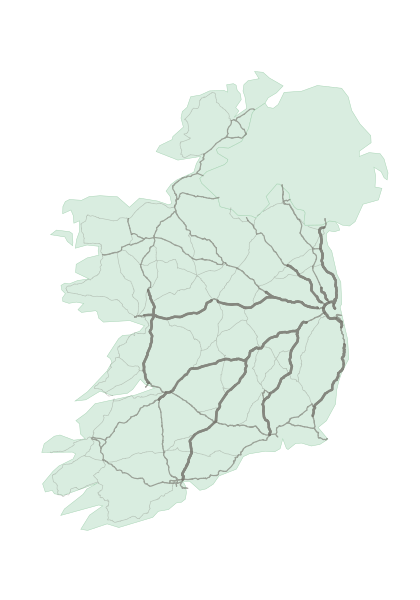
An intelligence report on any Irish site.
We merge Ireland's public registers — ownership, planning, land, build, sale — into one sourced picture of your site.
For decisions on Irish development that cannot afford to be wrong.
What an intelligence report surfaces.
A commissioned intelligence report runs against four core signals on any Irish residential site. Each is a join between registers that, independently, never speak to each other — and each is what separates a planning application from a viable scheme.
RZLT liability, pyrite and mica defect zones, flood maps, and 30+ other spatial overlays. On RZLT-liable land that has been recycled, 85% of new applications come from different applicants. Small developers sell under pressure, institutional buyers acquire at discount.
Permission expiry dates, extension-of-duration eligibility, and the statutory test for substantial works. At most one in twenty developers with expiring permissions files for an extension. The planning system's output is expiring faster than it is being replaced.
NZEB, Part V doubling, SHD abolition, Defective Blocks Act, RZLT, RPZ nationwide, Residential Tenancies Amendment Act. A developer who priced a scheme in 2019 budgeted for none of these. 22,769 residential permissions granted 2019-2021 sit in that window — roughly 170,000 units.
Median planning decision in Ireland in 2025 ran from 46 days in Dublin City to 97 in Roscommon. The 90th percentile stretches from 61 days in Wexford to 267 in Carlow. Every commissioned report benchmarks a site against its council's baseline and the p90 tail.
The themes we merge.
Every intelligence report is drawn from the same unified view of Irish land. Seven themes, joined at the planning application reference.
From the ongoing investigation.

Where Ireland Actually Builds: The Geography of What Gets Through
Towns get twice the scheme housing per capita of cities. Schemes within 500m of transport commence at 55%; schemes 1-2km away at 68%. The planning system allocates housing roughly where it's needed — then can't activate it where demand is tightest. The constraint map is the viability map.
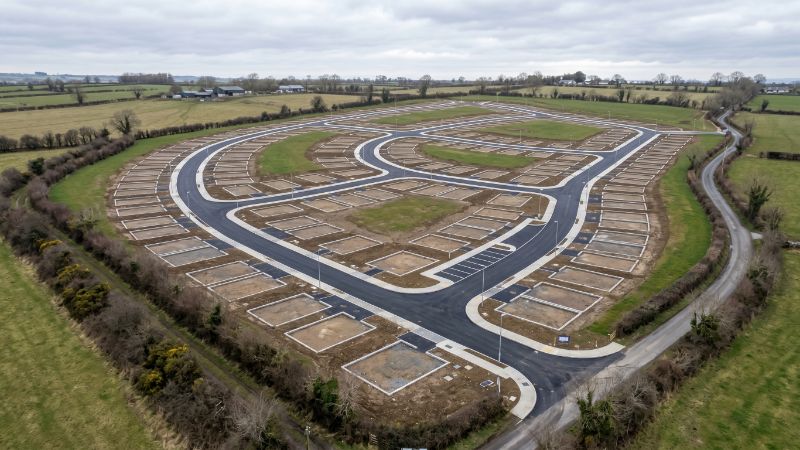
The Scale Trap: Too Small to Finance, Too Big to Survive
Roughly 400 residential developers receive scheme permissions each year. Three-quarters are first-time grantees averaging 43 units. The viable band starts at 61. There is no financing bridge between them. Above 100 units, even Cairn Homes and the LDA hold uncommenced 2021 SHD grants. Ireland's housing market is boxed in.
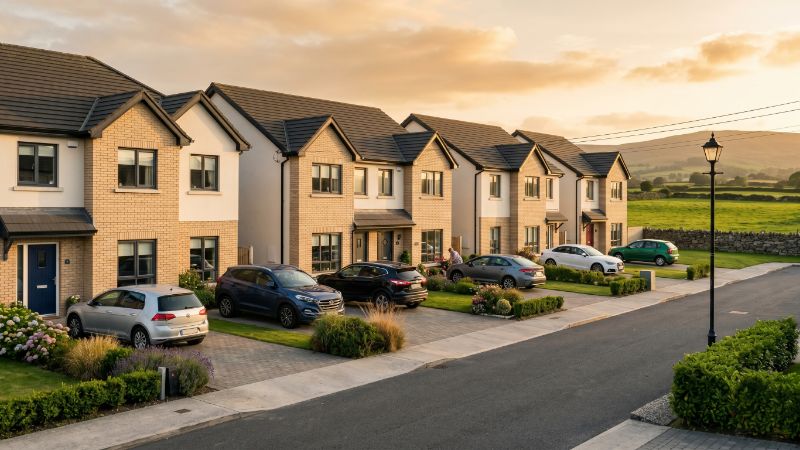
The Eye of the Needle: What Ireland Can Still Build
Mid-size schemes of 61-100 units commence at 68-76% across houses, apartments and mixed alike. One-off houses: 4,000 per year at 70%. Everything in between and above is where the system breaks. The viable band hasn't changed since 2017. The penalty for missing it has.
Every report runs against
An intelligence report on your site.
Commissioned, authored, and reviewed — every claim sourced to the document it came from. A single report covers the development envelope, every prior permission on or adjacent, refusal patterns by ground, ownership and SPV chain, infrastructure status, comparable sales, ABP trajectory, and the open questions that will decide the outcome.
Turnaround in days. Scope and pricing confirmed before any work begins.